Why TUS evidence is getting more scrutiny under AMS2750H and CQI-9
Heat treatment compliance has always mattered. What has changed is how often it is being checked, and how much evidence customers now expect to see.
Across aerospace and automotive supply chains, AMS2750H and CQI-9 are being applied with a sharper focus on furnace capability and measurement confidence. The question is simple: can the furnace be proven stable, accurate, and uniform at the temperatures it is meant to run? And can that proof be produced quickly, cleanly and consistently when an audit takes place?
For many operations, the pressure is not coming from new requirements. It is coming from the fact that the same requirements are being interpreted more strictly. The result is that temperature measurement is getting reviewed, not because the process is broken, but because the current method does not always stand up well under scrutiny.
The compliance question is Temperature Uniformity Survey (TUS), not “profiling”
A lot of people still use “temperature profiling” as a catch-all phrase. Under AMS2750H and CQI-9, it helps to be precise.
An AMS2750 Temperature Uniformity Survey (TUS) is about the furnace. It is designed to show that the qualified work zone can hold a target temperature within the allowed tolerance, and that it does so in a stable way.
A CQI-9 Temperature Uniformity Survey (TUS) is also about furnace performance but typically sits inside an automotive quality framework where evidence is expected to be repeatable, consistent, and easy to trace through a quality system.
From a measurement perspective, the common thread across both standards is the need to run TUS in a controlled and repeatable way.
Temperature profiling is different. Profiling is usually about the product or the load. It is used to understand what the parts experience through a cycle, and whether the process achieved the thermal conditions needed for the desired product metallurgical outcome. The thermal fingerprint allows full understanding, control and optimisation of the heat treat step to maximise quality, productivity and energy efficiency of the manufacturing process.
Both matter. They answer different questions. Most compliance issues sit in the gap between them, where a business has plenty of temperature data, but not the right type of data for the standard being applied.
What audits are challenging more often now
When auditors or customer quality teams focus on pyrometry evidence, they tend to focus on the same themes:
- Whether the TUS method is clearly aligned to the standard being referenced
- Whether the calibration trail is complete and traceable
- Whether the documentation is consistent across time, shifts, and sites
- Whether the organisation can reproduce the evidence without “special effort”
None of these are new ideas. The difference is that they are now being treated as routine expectations rather than best practice.
This is especially noticeable in supply chains where multiple sites are involved, or where parts move between subcontractors. If one supplier’s evidence looks different to the next, or if there is a visible break in traceability, it becomes a point of friction. The part may be fine. The paperwork becomes the problem.
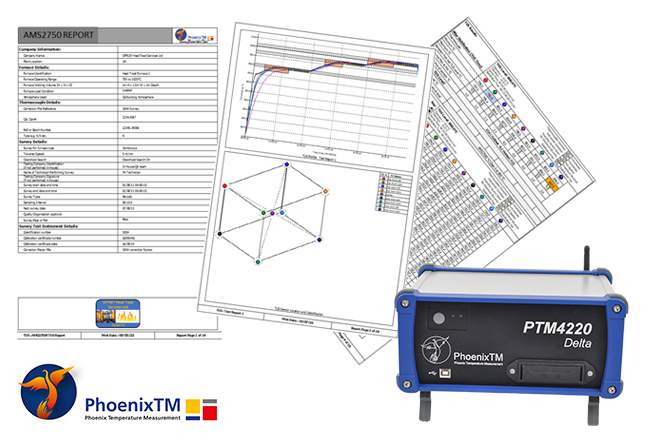
PhoenixTM Thermal View Survey software developed for TUS works offers a report generator template tool to ensure that all necessary TUS report criteria are included to prevent audit noncompliance.
Why this is getting reviewed internally
Many heat treaters can pass an audit when they have time to prepare. The harder test is whether the same level of evidence can be produced quickly, without rework, and without relying on one person who “knows how it’s meant to be done”.
This is where temperature measurement practices are being revisited.
Operations are looking closely at:
- How they run TUS in practice versus how they describe it in procedures
- How calibration records are stored and retrieved
- How they handle instrumentation offsets and corrections
- How they demonstrate stability, not just a pass result
The common thread is repeatability. The requirement is not only to do the work correctly, but to prove it in a way that stands up across time.
Where temperature profiling fits into the compliance conversation
Temperature profiling is not the centre of AMS2750H or CQI-9 compliance, but it does affect audit outcomes. A business can have strong TUS discipline but still struggle with process credibility if it cannot show that the load reached the required thermal cycle during a run. This is particularly relevant where:
- Loads vary significantly in mass or geometry
- Cycle times are being optimised
- There is a mix of product types on the same equipment
- Customers are sensitive to metallurgical outcomes
- There is a history of nonconformance or rework
In these cases, profiling is often used alongside TUS. TUS proves the furnace capability. Profiling supports confidence in the process being applied to the product.
This is also where a lot of confusion starts. If a team treats profiling data as “proof of uniformity”, they can end up with strong-looking graphs that do not answer the compliance question the auditor is actually asking.
Why this is becoming a strategic issue
For many manufacturers, AMS2750H and CQI-9 compliance now sits in the same category as customer approval status and supplier qualification. It influences who gets invited to quote, who stays on approved lists, and who is considered low risk.
That is why temperature measurement is being reviewed at management level, not just by engineers. The businesses that are coping best tend to have a clear internal separation between:
- TUS as furnace capability evidence
- Profiling as process and product evidence
When those areas are treated as distinct, it becomes much easier to build a compliance story that is consistent, defensible and scalable.
What “good” looks like in practice
Most operations do not fail audits because they never ran a TUS. They fail because the evidence does not hold together.
In practice, strong pyrometry compliance tends to look like:
- TUS schedules that are treated as non-negotiable
- Clear work zone definitions and stable survey methods
- Calibration records that are traceable and easy to retrieve
- Documentation that is consistent between people and shifts
- Results that can be presented quickly, without reformatting or interpretation
The Thermal View Survey Software report template allows auto population of consistent TUS criteria making the reporting step accurate, efficient and fully traceable.
Final thought
The standards have not suddenly become impossible. The expectation has simply moved closer to “show me the evidence” rather than “tell me you do it”.
In that environment, TUS stops being background engineering tasks. They become part of how a heat treater proves credibility, protects customer relationships, and stays competitive in aerospace and automotive supply chains.
If you need clearer, audit-ready TUS evidence for AMS2750H or CQI-9 compliance, speak to PhoenixTM about building a more traceable and repeatable approach to furnace monitoring.