The Rock & Roll of Log Monitoring
Real Thru-process Core Temperatures for Perfect Aluminium log Reheat.
The Homogenisation Heat Treatment Process
After casting, aluminium logs/billets undergo a homogenising heat treatment process to ensure uniform distribution of the alloying elements such as Zn, Cu, or Mg2Si and Fe within the structure of the log. This involves heating the log at a controlled rate, soaking at temperature (typically 480 °C to 540 °C / 896 °F to 1004 °F) for a specific period of time, and cooling at a specific rate to allow the precipitating elements to become more evenly distributed throughout the material. Each phase of the heat treatment process is temperature critical. An accurate means of monitoring the log internal temperature throughout the whole furnace cycle is, therefore, important to the success of the homogenisation process, material properties and efficiency of the furnace heat treat operation.
Log Temperature Measurement Challenge
When setting furnace conditions for new production batches, monitoring the actual product temperature of the logs throughout the furnace is vital to maximise production throughput, while ensuring the correct metallurgical structure of the product.
Measurement of the product temperature is generally not considered a problem when the operation is conducted in a batch furnace. In such case thermocouples can be run from the static logs, loaded in the furnace, to an external data logger without significant issues.
However, when homogenising is conducted in a continuous process, such as a walking beam furnace, monitoring the product temperature from a data logger external to the furnace is not possible because the logs generally travel in different directions as they enter, move through the hot zone, and exit the furnace. Also, the logs can slowly rotate due to the action of the walking beam. These factors make external monitoring with long trailing thermocouples impractical and even, if possible, will not comply with every increasing safety requirement for technical plant operatives.
The solution is to use a ‘thru-process’ temperature monitoring system where a thermal barrier can be attached to the log protecting a data logger as it gathers temperature data from thermocouples set within the test product. In this way the product temperature profile can be accurately monitored as the test product travels through the process. Short thermocouples are safely contained within the thermal barrier, before running along pre-cut routing channels within the log, eliminating the risk of tangling or being caught during the log movement through the furnace.
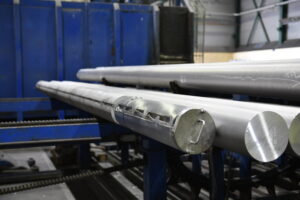
Fig 1: PhoenixTM TS57 Rotating Evaporative Water Barrier Solution Set-Up
System used to successfully monitor, in real time, the Homogenisation of cast aluminium logs in a walking beam furnace. The Rotating cylindrical water barrier attached to the aluminium log rotates safely as the log moves through the complete oven.
The innovative cylindrical thermal barrier design is critical to the success of the temperature monitoring system. The diameter and length of the thermal barrier matches a machined gap at the end of the aluminium log so that loading the log, with the monitoring system attached, can be achieved as if a standard log. No height restriction challenges are faced and most importantly being cylindrical the system can rotate safely with the log as it is transferred through the walking beam furnace.
The ‘thru-process’ Monitoring System Design Solution
The PhoenixTM ‘thru-process’ monitoring system to accommodate the size restrictions of the homogenising processes and its long duration (up to 10 hrs) / high temperature (600 °C/1112 °F), employs a phased evaporation method of thermal protection. The data logger in encased in thermally insulated cylindrical water tank employing evaporating water as a phase change medium. As the water reaches its boiling point it changes from liquid to gas (steam) as it evaporates but maintains the operating temperature of the logger at a safe
100 °C/212 °F so prolongs the period it can remain in the furnace. The thermal protection provided by the thermal barrier can be controlled by selecting the volume of the water tank and so water capacity (Litres).
The innovative barrier design must allow the steam to evaporate whilst not losing any water as the barrier rotates. For this type of system, it is also necessary for the data logger to be able to operate at 100°C as it is surrounded by boiling water (Figure 2. PhoenixTM TS57 Rotating Evaporative Water Barrier)
Having established the diameter range of the logs and the process parameters, the size of the system (length and diameter) can be calculated and a piece of the log equal to the length of the thermal barrier can be cut off and discarded. The end of the log is then machined to allow the thermal barrier to be secured directly with steel bolts. Alternatively, a custom mounting plate can be bolted to the end of the cut log to which the barrier can be efficiently fixed and removed from test to test. A slot is machined longitudinally along the log to guide the thermocouples to holes drilled at right angles to the correct measuring depth. This ensures that both the thermocouples and the ‘thru-process’ system are kept within the boundaries of the product (Figure 3).
When this is complete the thermocouples are positioned, the data logger reset and placed in the thermal barrier fixed to the test log, and the trial is ready to run.
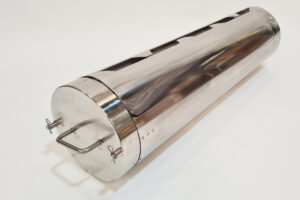
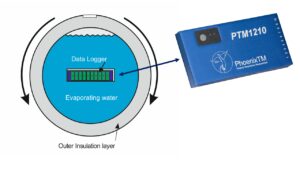
Fig 2. PhoenixTM TS57 Rotating Evaporative Water Barrier solution.
- Cylindrical thermal barrier fixed to aluminium log being monitored.
- Schematic showing the PTM1210 datalogger located in cylindrical water tank that rotates with the aluminium log during transfer through walking beam furnace.
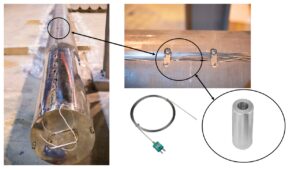
Fig 3: Thermocouple Installation
Installation of thermocouples on the aluminium log to allow of monitoring core temperatures in a machined channel along the length of the test piece. The thermocouple measuring tip (Hot junction) is inserted into aluminium bushes, located into drilled pilot holes, to required core depth in the log.
Winning Solution providing Accurate Process Validation
Requiring a solution to allow process monitoring of their walking beam aluminium log homogenisation furnace Service Center Metals (SCM) located in Prince George, VA, USA approached PhoenixTM.
The resulting ‘thru-process’ temperature monitoring system provided to SCM fitted with a RF telemetry module the data logger allowed live ‘Real Time’ product temperature to be monitored through the whole furnace. With such information SCM were able to validate mathematical models used to control the furnace and so optimise the efficiency of the entire homogenisation process.
Mr Calvin Wiggins, Quality Director at SCM, is quoted as saying “The ease of use of the PhoenixTM system allows us to do more surveys per year than compared to feeding thermocouple wires attached to a rigid log. However, its single best-selling point is improved safety by keeping tech’s away from the furnace entry door, where they would otherwise be feeding TC wires to the survey log as it advances through the furnace.”
Monitoring Power
Employing the ‘thru-process’ temperature monitoring solution from PhoenixTM major key casting plants have been able to measure the temperature profile of their aluminium log in all three stages of the homogenisation process. With such critical information it has been possible to minimise time in the soak zone to increase productivity and optimise fuel efficiency without compromising product quality.