How UKAS calibration expectations are influencing temperature measurement in thermal processing
In the UK heat-treatment sector, calibration is not treated as a mere administrative exercise. It underpins audit credibility, customer confidence, and compliance with standards such as AMS2750H and CQI-9.
When a business refers to UKAS calibration, it is effectively referring to traceability against national standards under ISO/IEC 17025. This traceable chain gives weight to temperature data. Without it, temperature evidence is far harder to defend during audits or supplier reviews.
The conversation in many organisations has shifted: it is no longer, “Are we calibrated?” but rather, “Can we demonstrate measurement confidence across the full operating range?”
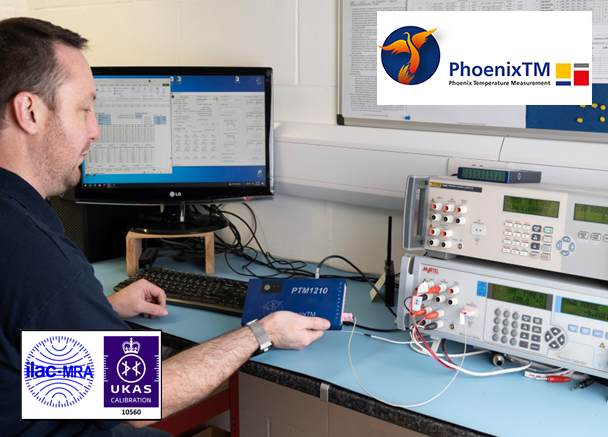
Calibration is the Foundation of Measurement Confidence
In thermal processing, the temperature value itself is rarely questioned in isolation. What is questioned is the chain behind it.
That chain typically includes:
- Calibration of the data logger or measurement instrument
- Calibration of thermocouples
- Application of correction factors
- Defined uncertainty values
- Traceability of certificates to recognised standards
UKAS-accredited calibration provides independent verification that this chain is controlled.
Under standards such as AMS2750H, accuracy requirements are defined within the instrumentation section (3.2), covering both measurement systems and thermocouples. Data loggers must meet specified accuracy limits. Thermocouples must meet defined tolerance classes. Correction factors must be applied appropriately.
The December 2024 editorial on AMS2750 TUS monitoring highlights the importance of applying correction factors across the full calibration range, rather than relying on a single nominal adjustment. This reflects a broader point: calibration is not a tick-box. It directly affects the integrity of Temperature Uniformity Survey (TUS) data.
Why UKAS matters during audit
Auditors rarely stop at “show me your TUS report.” They often move upstream and ask:
- When was the instrument calibrated?
- Who performed the calibration?
- Is the laboratory UKAS accredited?
- What is the stated uncertainty?
- Are correction factors applied consistently?
If the calibration laboratory is UKAS accredited, the conversation tends to move more quickly. The credibility threshold has already been met.
If it is not, more questions follow. Additional justification may be required. In some cases, customer-specific requirements may explicitly mandate UKAS-accredited calibration for critical measurement equipment.
This is particularly relevant where TUS is being used to demonstrate compliance to aerospace or automotive customers. The technical result may be sound, but without traceable calibration, the evidence becomes vulnerable.
Calibration, correction factors and real-world accuracy
In practice, temperature measurement in heat treatment is not static. Instruments operate across wide temperature ranges. Thermocouples age. Offsets can drift.
Recent industry guidance highlights that meeting calibration requirements on paper does not always guarantee accuracy on the shop floor. Real-world conditions such as ambient temperature variation, cold junction behaviour and thermal cycling can all influence measurement performance.
Correction factors therefore need to be applied across the full calibration range, rather than relying on a single nominal adjustment. Linear interpolation of correction factors across multiple calibration points ensures that temperature data remains accurate throughout the operating range.
This technical detail has direct implications for compliance. When calibration is handled properly:
- Reported temperatures reflect corrected values, not nominal readings
- Measurement uncertainty is understood, not assumed
- TUS results are based on defensible data
When calibration is weakly controlled, the opposite is true. A furnace may appear to pass a TUS on paper, but the underlying measurement system may not meet the required accuracy class.
For further detail on real-world measurement accuracy and correction factor implementation, see:
https://www.phoenixtm.com/wp-content/uploads/2026/03/HTT-Magazine-March-2026-PhoenixTM-TUS-CJ-Accuray.pdf
The link between UKAS calibration and TUS credibility
Temperature Uniformity Surveys are designed to prove that the qualified work zone of a furnace meets defined tolerances. That proof depends entirely on the integrity of the measurement system.
If the data logger calibration is out of date, or if thermocouple calibration history is unclear, the TUS result becomes questionable. The same applies more broadly to the measurement system. The test may have been run correctly, but if the reference instrument lacks traceable calibration, the evidence chain is broken.
From a quality systems perspective, UKAS-accredited calibration provides a structured way to protect that chain. It also supports internal governance. When calibration certificates are standardised, traceable and regularly reviewed, management can have confidence that compliance is not dependent on individual interpretation.
Intervals are customer determined on the basis of their own set-up, furnace classes and clear documented requirements in AMS2750H. AMS2750 Instrument Calibration Frequency – Table 7.
Procurement decisions are being influenced
In regulated sectors, procurement teams are increasingly aware of measurement risk. Where two suppliers appear technically similar, the one with clear, UKAS-traceable calibration processes may be viewed as lower risk.
This is particularly relevant in:
- Aerospace supply chains
- Automotive heat treatment
- Defence and energy sectors
- Any environment where audit exposure is high
UKAS calibration is therefore influencing not only engineering practice, but also supplier selection and approval.
A shift from compliance to assurance
The direction of travel is clear. Calibration is no longer treated as background maintenance. It is part of the compliance story.
In thermal processing, temperature data supports metallurgical properties, product safety and regulatory conformity. UKAS-accredited calibration strengthens the credibility of that data.
When calibration is properly controlled, TUS stands on solid ground. When it is not, even technically sound processes can become difficult to defend.
For UK heat treaters operating in regulated markets, UKAS calibration is becoming less of an option and more of an expectation.
If you need more confidence in the calibration evidence behind your TUS results, speak to PhoenixTM about strengthening the traceability, accuracy and audit-readiness of your thermal processing data.